

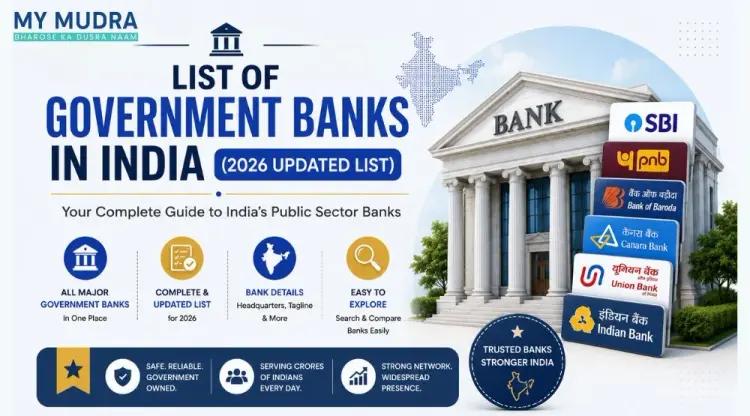
Government banks play a significant role in India's banking and financial system. Also known as Public Sector Banks (PSBs), these banks have substantial government ownership and provide a wide range of banking services to individuals, businesses, farmers, and government institutions. Understanding the list of government banks in India can help customers compare banking services, account options, loans, and other financial products.
What Are Government Banks in India?
Government banks are banks in which the Government of India holds a majority ownership stake. These banks operate under the regulatory framework of the Reserve Bank of India (RBI) and offer services such as savings and current accounts, fixed deposits, loans, credit cards, digital banking, and investment-related services.
Public sector banks have an important role in promoting financial inclusion and extending banking services to different sections of society, including customers in rural and semi-urban areas.
List of Government Banks in India 2025
The following is the government bank list in India comprising the 12 Public Sector Banks operating in 2025:
No. | Government Bank | Headquarters |
|---|---|---|
1 | State Bank of India | Mumbai |
2 | Bank of Baroda | Vadodara |
3 | Punjab National Bank | New Delhi |
4 | Canara Bank | Bengaluru |
5 | Union Bank of India | Mumbai |
6 | Bank of India | Mumbai |
7 | Indian Bank | Chennai |
8 | Central Bank of India | Mumbai |
9 | Indian Overseas Bank | Chennai |
10 | UCO Bank | Kolkata |
11 | Bank of Maharashtra | Pune |
12 | Punjab & Sind Bank | New Delhi |
This list of government banks in India reflects the Public Sector Banks that were operating in 2025.
1. State Bank of India
State Bank of India (SBI) is India's largest public sector bank by size and has a large network of branches and ATMs across the country. It provides retail banking, personal loans, home loans, education loans, business banking, agricultural finance, investment services, and digital banking facilities.
2. Bank of Baroda
Bank of Baroda is one of India's major public sector banks. It offers savings accounts, current accounts, personal loans, home loans, vehicle loans, business loans, agricultural finance, fixed deposits, and digital banking services.
3. Punjab National Bank
Punjab National Bank (PNB) is one of India's oldest major public sector banks. It serves retail, corporate, agricultural, and small-business customers. Its product range includes deposits, loans, credit facilities, and digital banking services.
4. Canara Bank
Canara Bank provides banking services to individuals, businesses, farmers, and other customer segments. Its offerings include savings accounts, fixed deposits, personal loans, home loans, education loans, MSME finance, and agricultural loans.
5. Union Bank of India
Union Bank of India is another major name among government banks in India. It offers retail and corporate banking products, including personal finance, home loans, vehicle loans, business loans, deposits, and digital banking services.
6. Bank of India
Bank of India provides a variety of financial services for retail customers, businesses, MSMEs, and agricultural customers. Its services include deposits, loans, investment products, and digital banking facilities.
7. Indian Bank
Indian Bank is headquartered in Chennai and provides banking services across retail, agriculture, MSME, and corporate segments. Customers can access savings accounts, deposits, loans, and digital banking services.
8. Central Bank of India
Central Bank of India is one of the country's established public sector banks. It provides retail banking, agricultural finance, MSME loans, corporate banking, deposits, and other financial services.
9. Indian Overseas Bank
Indian Overseas Bank (IOB) offers banking and financial services to individuals, businesses, agricultural customers, and other segments. It provides deposit accounts, loans, remittance facilities, and digital banking services.
10. UCO Bank
UCO Bank is a public sector bank headquartered in Kolkata. It offers savings and current accounts, fixed deposits, loans, MSME financing, agricultural banking, and various digital services.
11. Bank of Maharashtra
Bank of Maharashtra is headquartered in Pune and has a strong presence across different parts of India. Its products include deposits, retail loans, MSME finance, agricultural loans, and digital banking services.
12. Punjab & Sind Bank
Punjab & Sind Bank is a public sector bank headquartered in New Delhi. It provides retail, agricultural, MSME, and corporate banking services, along with deposit and loan products.
Key Features of Government Banks
The government bank list in India includes institutions that provide several important financial services. Some common features include:
Savings and current accounts
Fixed and recurring deposits
Personal loans
Home and education loans
Vehicle loans
Business and MSME loans
Agricultural loans
Internet and mobile banking
Debit and credit card services
Domestic and international remittance services
Government banks also participate in various financial inclusion initiatives and government-backed banking programmes.
Government Banks vs Private Banks
The primary difference between government and private sector banks is ownership. Public sector banks have majority government ownership, whereas private sector banks are primarily owned by private shareholders.
Both categories are regulated by the RBI and provide similar basic banking services. However, their product terms, interest rates, fees, digital facilities, branch networks, and customer-service processes can differ.
Therefore, customers should compare the applicable terms and conditions before opening an account or applying for a financial product.
Why Are Government Banks Important?
Government banks have historically played an important role in expanding formal banking services throughout India. Their extensive branch networks help provide banking access in rural and semi-urban areas. They also support agriculture, MSMEs, infrastructure, education, housing, and other sectors through various lending programmes.
For customers looking for a bank with a large branch network and a broad range of traditional banking services, understanding the list of government banks in India can be a useful starting point.
Conclusion
The government banks in India form an important part of the country's financial infrastructure. In 2025, India had 12 Public Sector Banks, including State Bank of India, Bank of Baroda, Punjab National Bank, Canara Bank, Union Bank of India, Bank of India, Indian Bank, Central Bank of India, Indian Overseas Bank, UCO Bank, Bank of Maharashtra, and Punjab & Sind Bank.